
 By
By Claude for Employee Performance Reviews: The Complete HR Playbook
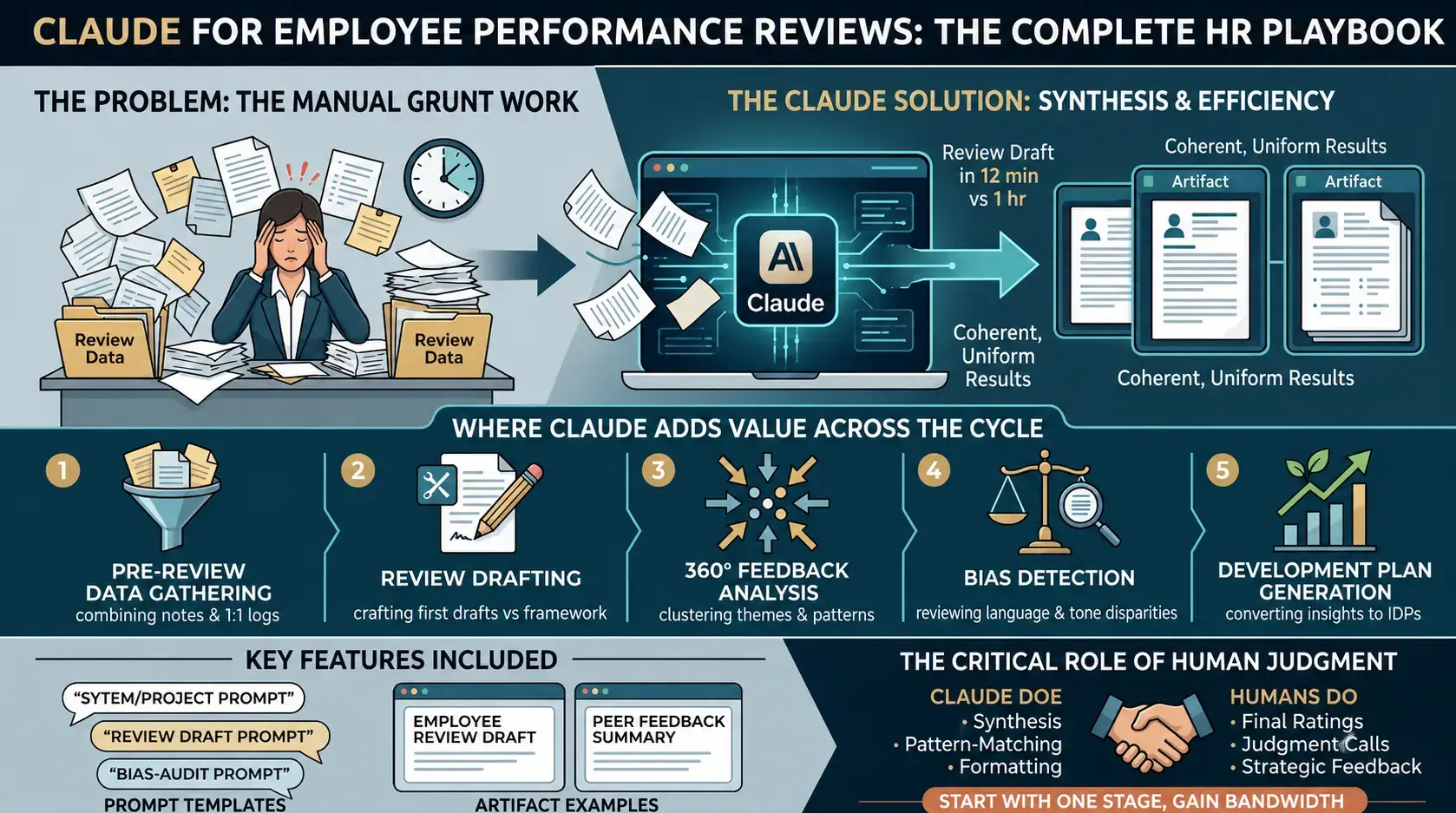
Performance review season has a way of arriving before you feel ready. One week, you are managing one-on-ones and hiring pipelines. Next, you are staring down 40 employees and a deadline that crept up on you.
The problem is rarely judgment. It is the grunt work — pulling six months of scattered notes into coherent and uniform results. Then, repeat it for the next person on the list.
I spent over a decade in HR before AI tools convinced me. What changed my mind was not a demo. It was watching a colleague finish a review draft in 12 minutes that would have taken me an hour. And it was genuinely good.
This playbook is a practical and honest look at where Claude earns its place in the review cycle. And where your judgment stays irreplaceable.
In This Guide
|
The Performance Review Problem Nobody Talks About
Let me be blunt: most performance review processes are broken, and HR teams know it.
We spend immense energy executing a system that neither managers nor employees trust. And wonder why nothing changes after review season ends.
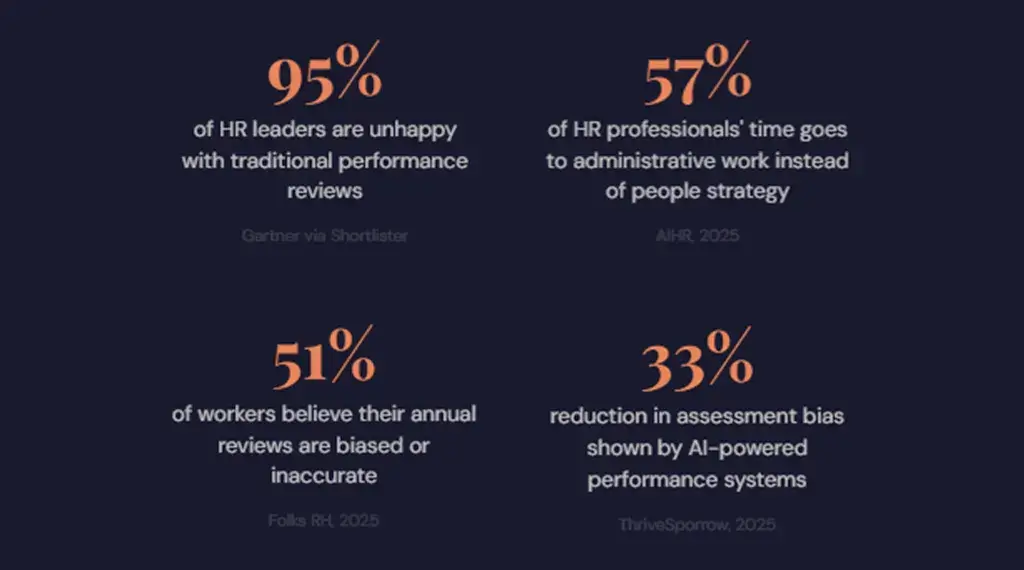
This is not a people problem. It is a process problem.
The cognitive load of combining six months of scattered notes, client feedback, and other data into a coherent, legally defensible report is time-consuming.
Claude does not replace that judgment. But it handles the synthesis burden so you can focus on the judgment.
I have been in the HR field for more than a decade. When AI-assistance started showing up in our workflows, my first instinct was scepticism. I questioned, “Can these tools work better than humans?”
But this is what changed my mind: watching a 45-minute review-writing task being completed within 12-minutes (with a better result). That’s when I started paying real attention.
What Existing Guides Get Right (And Where They Stop)
A few high-quality resources have covered the basics of using Claude for performance review efficiently. These include:
- Substack’s guide on using Claud to create a performance review
- Sprad’s analysis of Claude Cowork for HR
- AIHR’s hands-on experiment
These guides explain how to:
- Give Claude a skills framework and employee data as system context.
- Use Artefacts to generate formatted review drafts.
- Prompt Claude with structured employee notes for a consistent tone.
- Use the slash command in Claude Cowork for structured HR workflows.
Unequivocally, these are real and use capabilities. But they have strongly treated Claude as a drafting assistant (a faster way to produce text).
They stop well short of what Claude can actually orchestrate across the full review cycle.
| The Missing Insight: Claude is not just a writing tool for reviews. It’s a thinking partner that can handle calibration prep, bias-checking, development planning, and even cross-team consistency analysis – tasks that currently eat hours and deliver inconsistent results. |
What Claude Can Actually Do in a Performance Review Cycle
Here is the fuller picture of where Claude adds genuine value, organised by the stage of the process:
| Review Stage | What Claude Can Do | Time Saved (est.) |
|---|---|---|
| Pre-review data gathering | Combine notes, emails, and 1:1 logs to form a solid track record | 30-45 minutes/employee |
| Purpose | Help employees to arrange their own inputs using the STAR format | 20-30 minutes/employee |
| Review drafting | Craft a first draft measured against the skill framework and rating | 30-40 minutes/employee |
| 360-degree feedback analysis | Cluster peer feedback themes, find differences, surface patterns | 20-35 minutes/employee |
| Calibration preparation | Draft comparative summaries across a team; flag potential rating inconsistencies | 1-2 hours/team |
| Bias detection | Review language and tone disparities by gender or role type | 1-3 hours/cycle |
| Development plan generation | Convert review insights into a formatted 90-day or annual IDPs | 20-30 min/employee |
| Post-review documentation | Draft follow-up meeting agendas and action plans tailored to each review | 10-15 minutes/employee |
Table 1: Showcasing the sections Claude can work on for employees’ performance review to save time and attain better outcomes
Note that the last three rows – bias detection, development plan generation, and post-review documentation – are where almost no one talks.
These are also where HR teams spend unreasonable time in larger organisations. And where Claude’s long-context windows (up to 200k tokens) become a genuine strong advantage.
Prompt Templates and Artefacts Examples
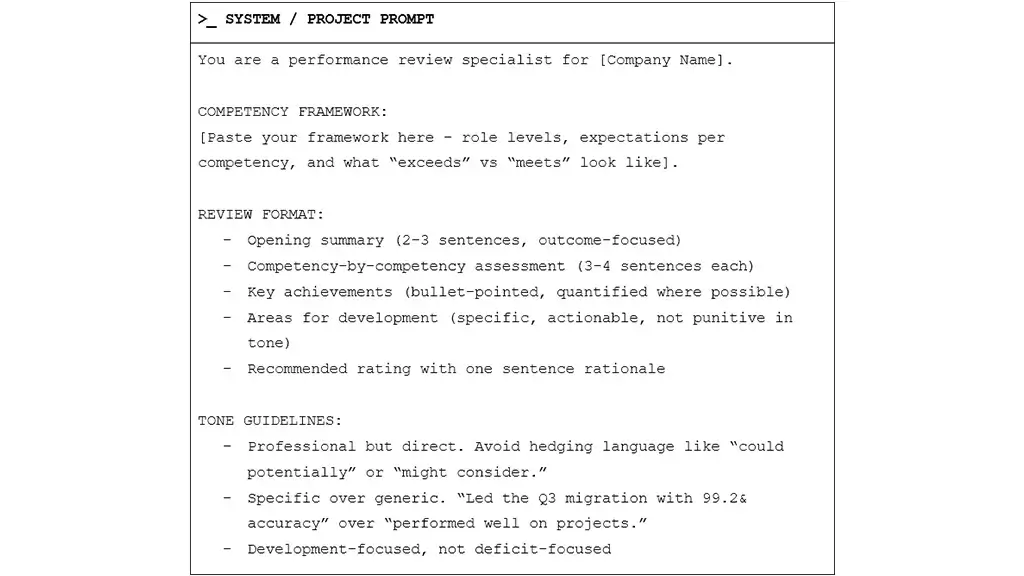
What Claude produces is almost entirely a function of what you give it. Vague input generates generic outcomes.
So here are the four prompts I rely on:
1. The Context-Loading Prompt (do this once per cycle)
2. The Review Draft Prompt (per employee)
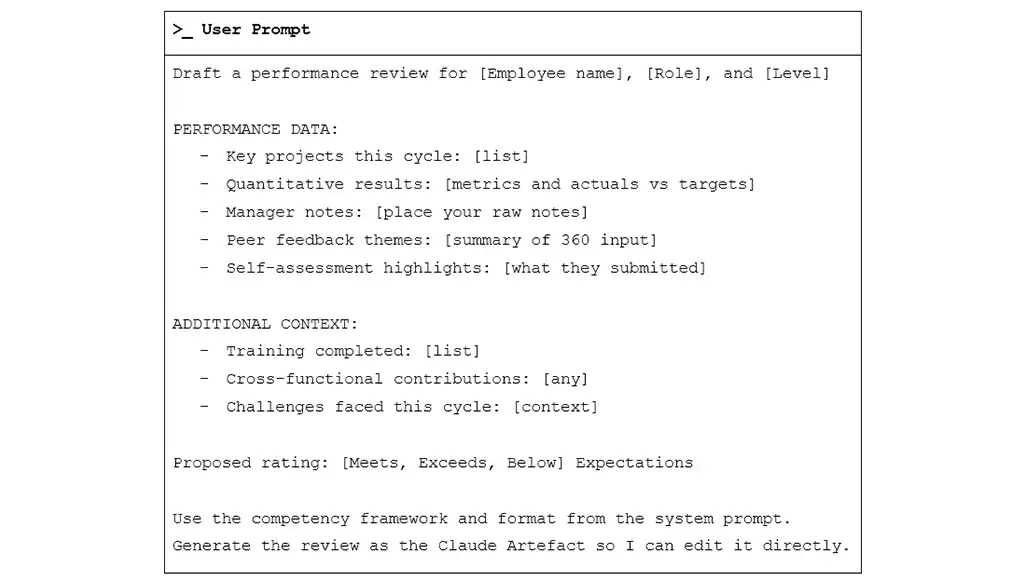
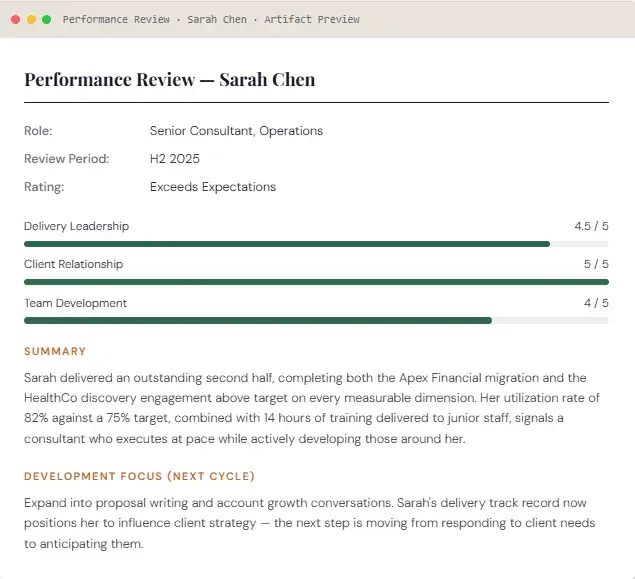
On applying this, here is what Claude’s Artefact output looks like for an employee:
3. The Bias-Audit Prompt (run across a team)
A perfect prompt is the game-changer, especially for those who rely on the Best HR Assignment Writing Services for their organisational reports that meet professional standards.
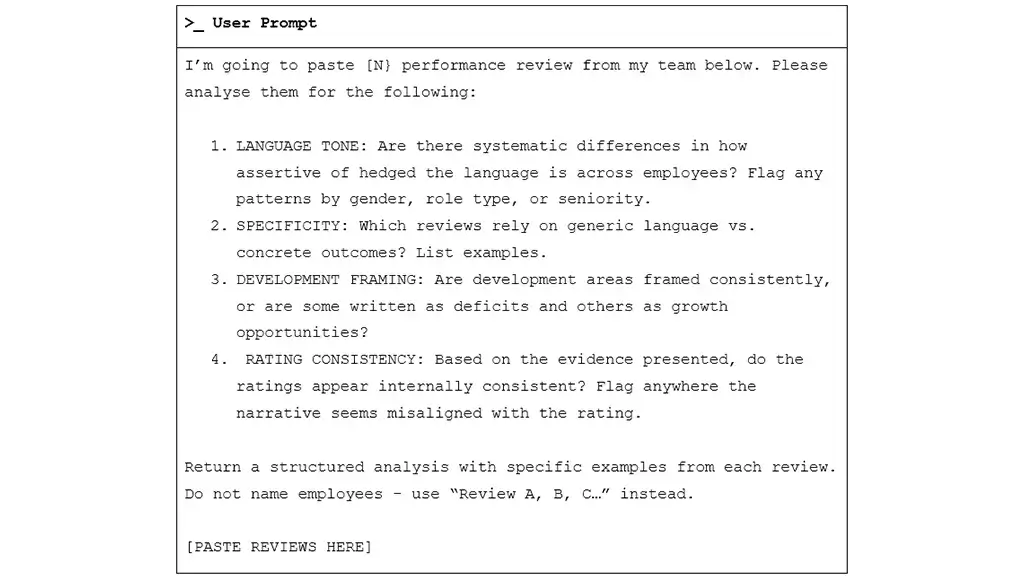
This one prompt can surface the kind of arrangement issues that HR teams typically spend a full afternoon trying to find out manually.
I have used a version of it to catch gendered language patterns that were not visible review-by-review. But it became obvious when Claude compared them side by side.
Honest Limitation and Where Human Judgment Remains Essential
Just like any other AI tool, Claude also has some limitations. And this is where the human eye fills the gap.
| Task | Claude’s Reliability | What to watch for |
|---|---|---|
| First-draft generation | High | This will still need human judgment on tone and political context |
| Structuring 360 feedback | High | May provide recent or vivid examples if it’s not prompted properly |
| IDP development | High | Resource suggestions can be generic. |
| Bias auditing | Medium-high | It is useful for flagging, but not for concluding. So always review flagged cases yourself |
| Compensation benchmarking | Low at the senior level | Do not rely on Claude alone; use verified market data sources |
| Rating recommendations | Low | Claude can draft a rationale. But it should never be the source of a rating decision |
| Disciplinary documentation | Use with caution | Legal and HR policies often change. So always have a legal review yourself |
Wrapping Up!
The goal was never to remove humans from performance reviews. It is to remove the parts that were never really human work — synthesis, pattern-matching, formatting across dozens of documents at once.
The judgment calls still belong to you. They always will.
What Claude gives you is bandwidth. Start with one stage, run a real cycle, and see what changes. The teams winning here are not the ones who handed the process to AI. They are the ones who stopped wasting their expertise on the wrong things.