 By
By Top 5 HR Strategic Models Used in CIPD Assignments
Whether you are studying for a CIPD qualification level 3, 5, or 7, you will almost certainly be asked to apply strategic HR models in your assignments. These models are not just academic boxes to tick. They give you a proper framework for thinking about people, business, and how the two connect.
In this blog, we will discuss the top five most commonly used HR strategic models in CIPD work. Each one comes with context, how it applies in practice, and what makes it useful in your assignments.
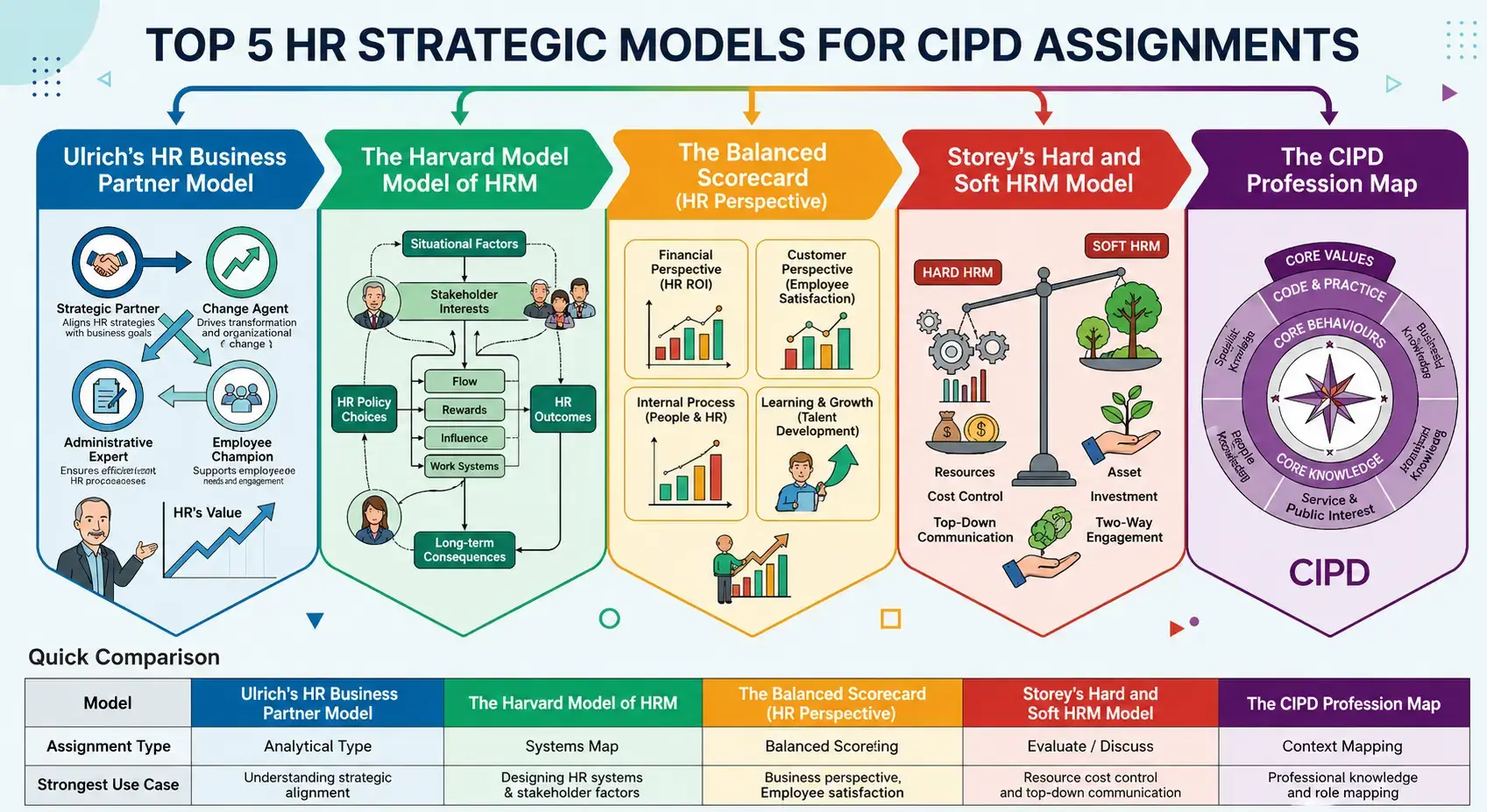
Ulrich’s HR Business Partner Model
Dave Ulrish introduced this model in 1997, and it remains one of the most referenced frameworks in HR. This framework helps organise a company’s HR function so that it can deliver strategic business value. It helps HR move away from being purely administrative and positions it as a genuine strategic partner to the business.
The model breaks HR into four main key roles:
- Strategic Partner: It aligns HR with business goals.
- Change Agent: It leads and manages organisational change.
- Administrative Expert: It keeps HR processes efficient.
- Employee Champion: It advocates for staff wellbeing and engagement.
The Ulrich model is widely used and is popular for the following reasons:
- This model helps in creating a more flexible and responsible HR organisation
- It promotes collaboration throughout the company
- It ensures alignment between HR practices and the organisation’s strategy and objectives.
In the CIPD assignments for level 5 or level 7 assignments, this model helps you argue how HR adds real business value. Also, it is especially useful when answering questions about organisational design or workforce strategy.
The Harvard Model of HRM
The Harvard Model of HRM was developed at Harvard Business School in 1984. This model takes a broad view of HR and argues that HR decisions are shaped by both internal stakeholders and situational factors, such as the economy, workforce characteristics, and management philosophy.
The Harvard model maps four key HR policy areas:
- Human resource flows (recruitment, selection, appraisal)
- Reward systems (pay, benefits, recognition)
- Employee influence (voice, involvement, communication)Work systems (job design, team structures)
This model is useful for CIPD assignments on stakeholder engagement or well-being because it forces you to consider multiple perspectives and not just the employers’ interests.
The Balanced Scorecard (HR Perspective)
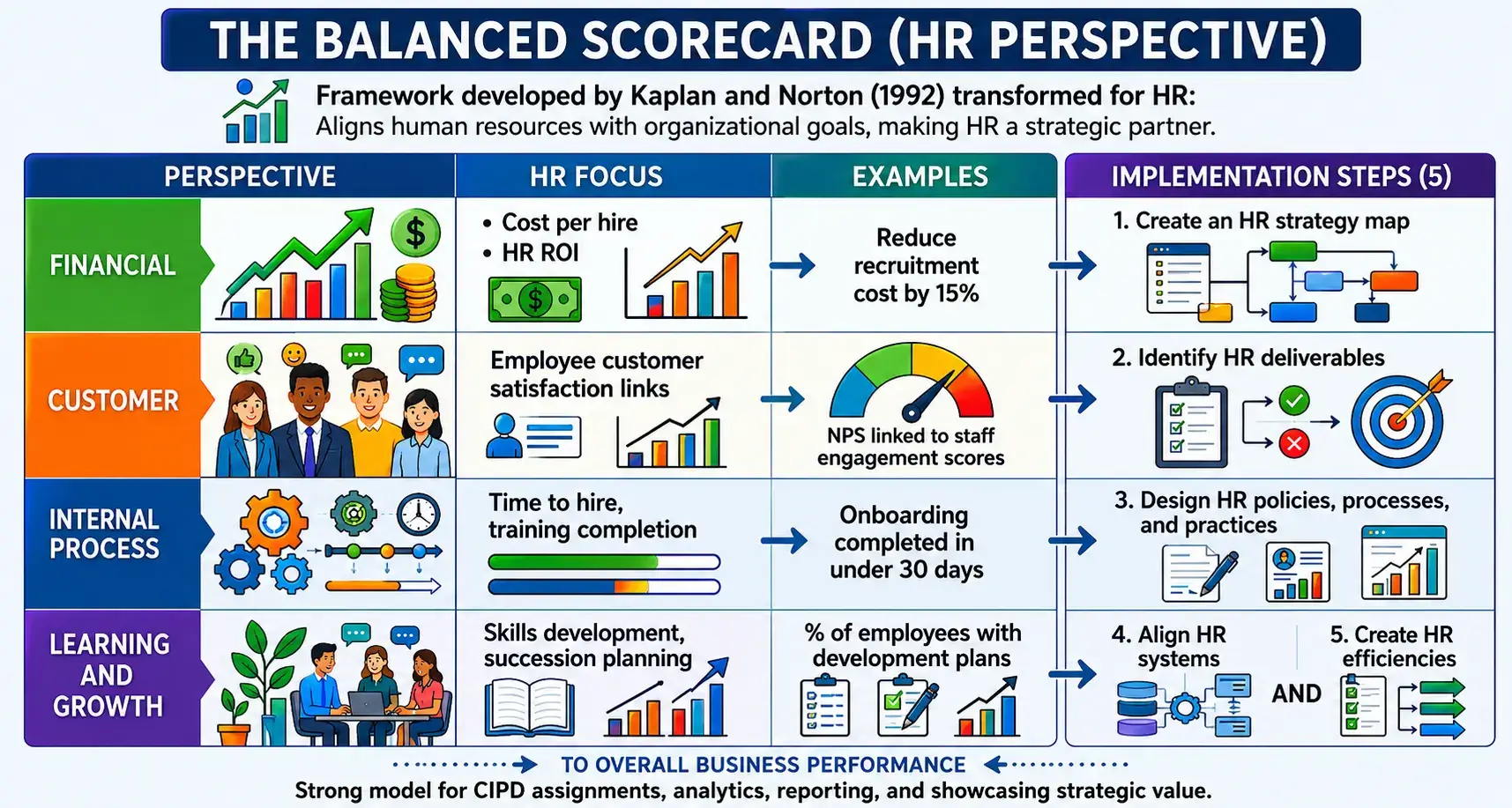
This framework was originally developed by Kaplan and Norton in 1992 as a business performance tool. But now, the Balanced Scorecard is widely adopted for HR use. It helps to align human resource activities with organisational goals. This is also another framework that transforms HR from an administrative function into a strategic partner.
The Balanced Scorecard framework connects people management to overall business performance across four key areas:
| Perspective | HR Focus | Examples |
|---|---|---|
| Financial | Cost per hire, HR ROI | Reduce recruitment cost by 15% |
| Customer | Employee customer satisfaction links | NPS linked ot staff engagement scores |
| Internal Process | Time to hire, training completion | Onboarding completed in under 30 days |
| Learning and Growth | Skills development, succession planning | % of employees with development plans |
Here’s how you can implement the HR scorecard in five simple steps:
- Create an HR strategy map
- Identify HR deliverables
- Design HR policies, processes, and practices
- Align HR systems
- Create HR efficiencies
The Balanced Scorecard is one of the strongest models you can apply to a CIPD assignment that involves analytics, reporting, or showcasing strategic value.
Storey’s Hard and Soft HRM Model
This model was introduced by John Storey in 1989, and is widely referenced in CIPD levels 5 and 7. Storey’s model draws a clear line between two very different ways of managing people.
Understanding the difference helps you critically evaluate how organisations treat their workforce. This is what CIPD assignments ask you to do.
| Dimension | Hard HRM | Soft HRM |
|---|---|---|
| View of employees | A resource to manage | An asset to invest in |
| Focus | Efficiency, cost control | Engagement, development |
| Contracts | Transactional | Relational, psychological |
| Communication | Top-down | Two-way, open |
Most UK organisations are often somewhere between the two. They use both sides of the framework as per the demand of the situation. If you need to apply this model in your assignment, then avoid treating it as a simple either/or. Instead, show that you understand the nuance.
Whether you are working independently or seeking support from CIPD Experts London, understanding these frameworks will always give your CIPD assignments a credible edge.
The CIPD Profession Map
The CIPD Profession Map was redesigned in 2018. It is used as a core benchmark for all CIPD qualifications.
This one is not just a model for your assignments. It is the foundation of what CIPD stands for. The Profession Map outlines the values, knowledge, and behaviours expected of HR professionals at every career stage.
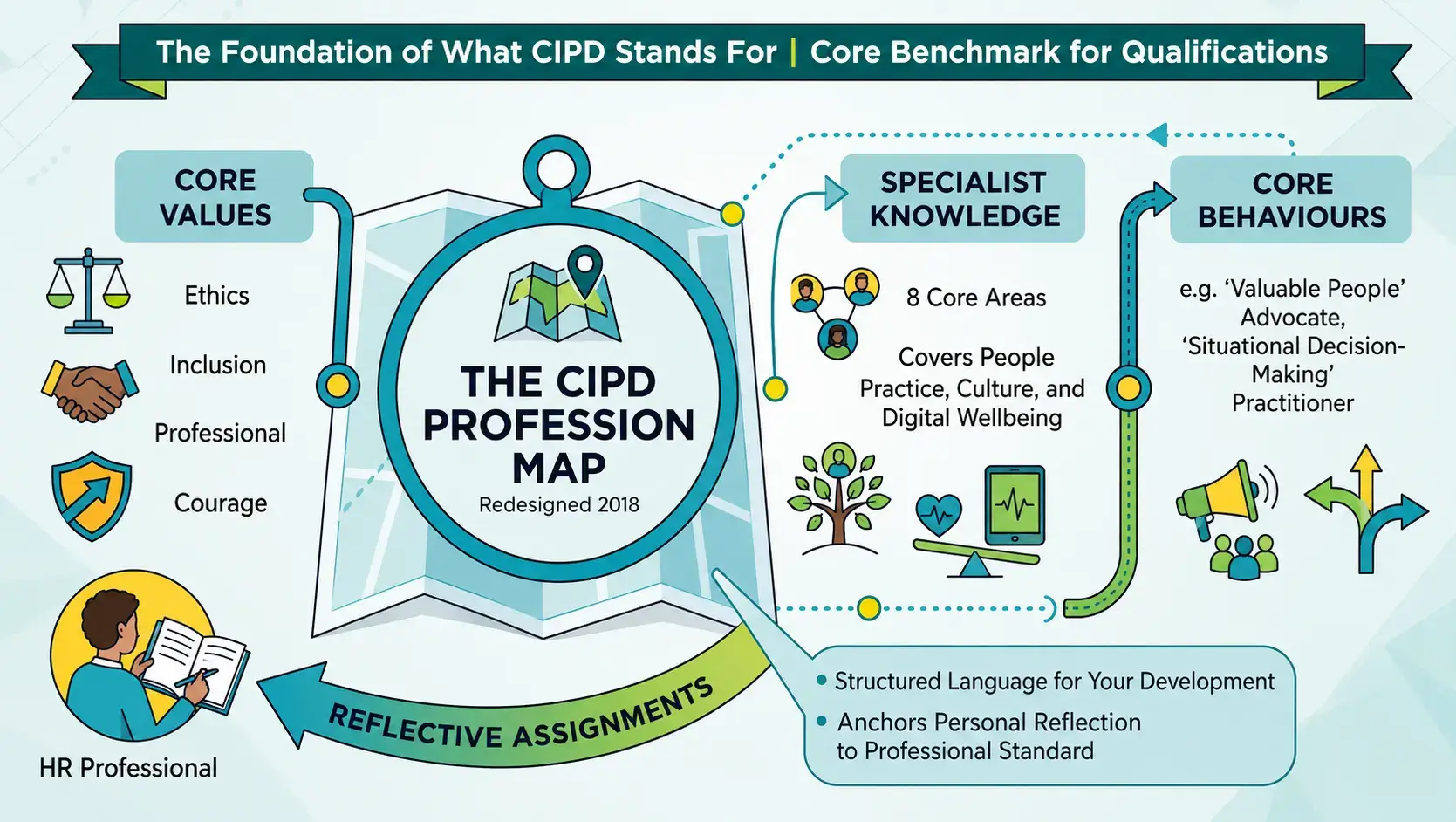
It covers three core areas:
- Core Values: Ethics, inclusion, professional courage
- Specialist Knowledge: It covers 8 core knowledge areas, including people practice, culture, and digital wellbeing
- Core Behaviours: These include being a ‘Valuable People’ advocate or ‘Situational Decision-Making’ practitioner.
Most CIPD modules include reflective assignments. This map gives you a structured language to describe your own development. You can use it to anchor your personal reflection to a recognised professional standard rather than just talking about yourself generally.
Relevant HR Models for CIPD Level 3, 5, and 7
| CIPD Level | Primary model used | Main focus |
|---|---|---|
| Level 3 | Profession Map, Harvard Model | Foundations of HR practice |
| Level 5 | Ulrich, Storey, Balanced Scorecard | People management strategy |
| Level 7 | All five + critical evaluation | Strategic leadership and change |
Quick Comparison: When to Use Each Model
| Model | Assignment Type | Strongest Use Case |
|---|---|---|
| Ulrich’s BP Model | Strategy, organisation design | Showing HR’s strategic value |
| Harvard Model | Stakeholder, wellbeing | Multi perspectice analysis |
| Balanced Scorecard | Analytics, measurement | Linking HR to business outcomes |
| Storey’s HRM | Critical analysis | Comparing management philosopjies |
| CIPD Profession Map | Reflective, CIPD | Professional development framing |
Final Words
These five models are not meant to be used in isolation. The distinction-worthy CIPD assignments are the ones that bring two or three models together and show how they complement or even challenge each other.
Knowing which model fits which question is itself a strategic skill. Remember that strategic thinking is not the most valued capability in HR teams. So this starts with understanding the frameworks that shape it.
FAQs
1. Which HR model is best for CIPD level 3?
CIPD Level 3 focuses on the foundations of HR practice. The CIPD Profession Map is perfect for reflective tasks and understanding professional standards. While Harvard Model is best for introductory assignments regarding stakeholder engagement and the general employer-employee relationship.
2. Is Harvard still relevant in modern HR?
Yes, the Harvard model is highly relevant because it acknowledges the situational factors that influence HR. These include government policy, economic conditions, and union influence. It is a powerful tool to analyse why an organisation adopts a specific people strategy rather than just looking at the internal HR processes.
3. How do I choose between hard and soft HRM in writing?
Firstly, do not view hard and soft HRM as a strict binary. You must use Storey’s Model to analyse the nuance of an organisation’s approach. Also, most UK organisations use a hybrid strategy. So when working on your assignment, identify the specific context (e.g, a crisis requiring cost-cutting vs. a growth phase requiring retention) to explain why an organisation might shift emphasis between hard efficiency and soft development.
4. Why should I use the CIPD Profession Map in my reflection?
The CIPD Profession Map provides a standardised language for HR competencies. When using this model, you move away from subjective “i feel” statements and instead map your skills and behaviours to industry-recognised benchmarks like ‘Situational Decision-Making’. This adds professional credibility to your reflective practice and shows your commitment to the standards set by the CIPD.