
 By
By The way people learn has always been a significant aspect of education and personal growth. There are those who like reading and those who learn by listening or doing.
This is exactly where we need Learning Style Theories.
It assists in understanding why some people receive information differently and how the teaching strategies can be altered according to those preferences.
So, in this blog, we will understand what theories of learning styles are, what the idea of learning style entails, the most popular models of learning style, and how these theories can be applied in real-life learning settings.
What is Learning Style Theory?
The concept of learning style theory is that people prefer certain methods of learning. Such preferences determine their information processing, comprehension and storage. This theory does not embrace the one-size-fits-all method since it requires the educator to apply their teaching approaches according to the needs of the learners.
For example, some learners understand better through visuals like diagrams and charts, while others prefer listening to lectures or engaging in hands-on activities. With the understanding of these preferences, teachers and students can then enhance the learning process.
The Importance of Learning Style Theories
Learning is not only about memorising something, but it is also about comprehending and putting knowledge into practice. This is why the theories of learning styles are said to be significant in academic and professional contexts.
They are important because they:
- Assist the students in learning better
- Enhance strategies of teaching
- Improve student engagement
- Support personalized learning
- Boost motivation and confidence among learners
When students learn at their own pace, they stand the chance of succeeding and being comfortable with the learning material.
Key Concepts in Learning Style Theory
In order to learn more about the learning styles, one should be familiar with the fundamental principles of learning styles.
1. Individual Differences
All learners are different. Some people understand things easily by images, and others require lectures or practice. These differences are dealt with in learning style theory.
2. Preferred Learning Modes
It means how an individual likes to learn. It may be visual, auditory, reading/writing or kinesthetic.
3. Flexibility in Learning
People do have a taste, but it is not a single style. Successful students tend to employ a combination of styles based on the context.
4. Learner-Centred Approach
This idea changes the perspective of teaching to learning. It promotes the use of approaches to accommodate the learner instead of asking the learner to adjust to the instructional approach.
Popular Learning Style Models
A number of models have been proposed to explain the learning theories and learning styles over the years. And now we will have a look at some of the most famous ones.
1. VARK Model
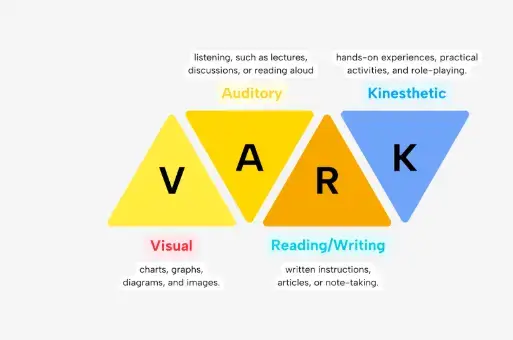
One of the most popular models is the VARK. It classifies learners into four groups:
- Visual (V): Study by pictures, maps and diagrams.
- Auditory (A): Study by listening and discussions.
- Reading/Writing (R): Prefer the method of text-based input and output
- Kinesthetic (K): Learn by doing.
It is a very easy model that is common in classrooms and in training programs.
2. Kolb’s Experiential Learning Theory

David Kolb developed a model that emphasises experience-based learning. Learning is a cycle, according to him, which involves:
- Concrete Experience
- Reflective Observation
- Abstract Conceptualization
- Active Experimentation
The model provided by Kolb demonstrates the relationship of learning styles and theories with real-life experiences and reflection.
4. Honey and Mumford Model
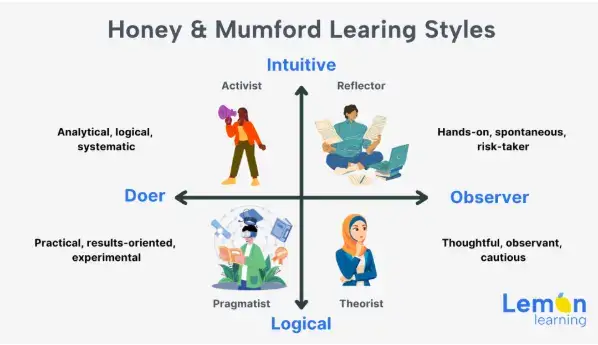
The model is founded on the work of Kolb, and it has four kinds of learners:
- Activists
- Reflectors
- Theorists
- Pragmatists
Both types have their most preferred mode of learning, and the knowledge of these may assist in developing superior training programs.
Learning Styles vs Learning Theories
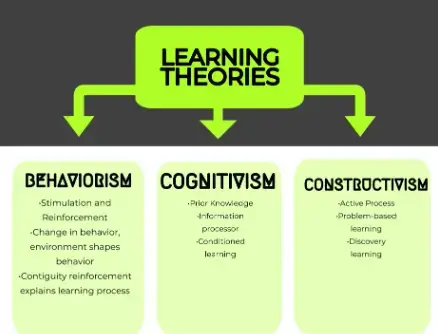
Learning styles should not be confused with general learning theories. Whereas learning styles emphasise the way people like to learn, learning theories describe how learning occurs in general.
For example:
- Behaviourism is concerned with learning as a reward and punishment.
- Cognitivism is the study of mental processes.
- Constructivism is focused on learning through experiencing.
The combination of the learning types and theories contributes to the comprehensive picture of the learning process. One explains the process, while the other one defnes the process of doing it.
Benefits of Understanding Learning Styles
Being aware of your learning types can go a long way in studying or working. These are some of the major advantages:
Improved Learning Efficiency
You learn concepts more quickly when you apply the type of methods that are best suited to you.
Better Retention
You will better recall information that you learned according to your preference.
Increased Engagement
The process of learning is much more engaging and less demanding.
Personalised Study Techniques
You are able to make study plans that best suit you.
So, learning styles theory is favoured by many educators and professionals. Even popular writing services like CIPD Assignment Help endorse this theory as an effective one.
Criticism of Learning Style Theory
Although the learning style theory is widespread, it does not go without criticism. Researchers believe that there is not much scientific evidence which proves the concept that teaching based on learning types has a significant positive impact.
Some of the typical criticisms are:
- Insufficient research evidence.
- Oversimplification of the learning processes.
- Risk of categorising the learners into predetermined groups.
Regardless of this, a lot of educators find it useful to use learning types as a guideline and not as a law.
Final Thoughts
The learning style theory provides an easy but effective means to learn about the process of learning. Although it might not be flawless, it is useful in that it gives insights that can enhance the teaching and learning experiences.
Through learning the various concepts of learning types theory and putting them into practice in the day-to-day study routine, learners can be more confident and effective. Meanwhile, teachers will be able to establish more interactive and inclusive classrooms.
Ultimately, this is not aimed at confining oneself to a single style but rather to be an elastic learner who will be able to adjust to various circumstances. This is the true secret of success in the long-term in education and more.